WBO president responds to Hamzah Sheerazs corruption allegations over Jan
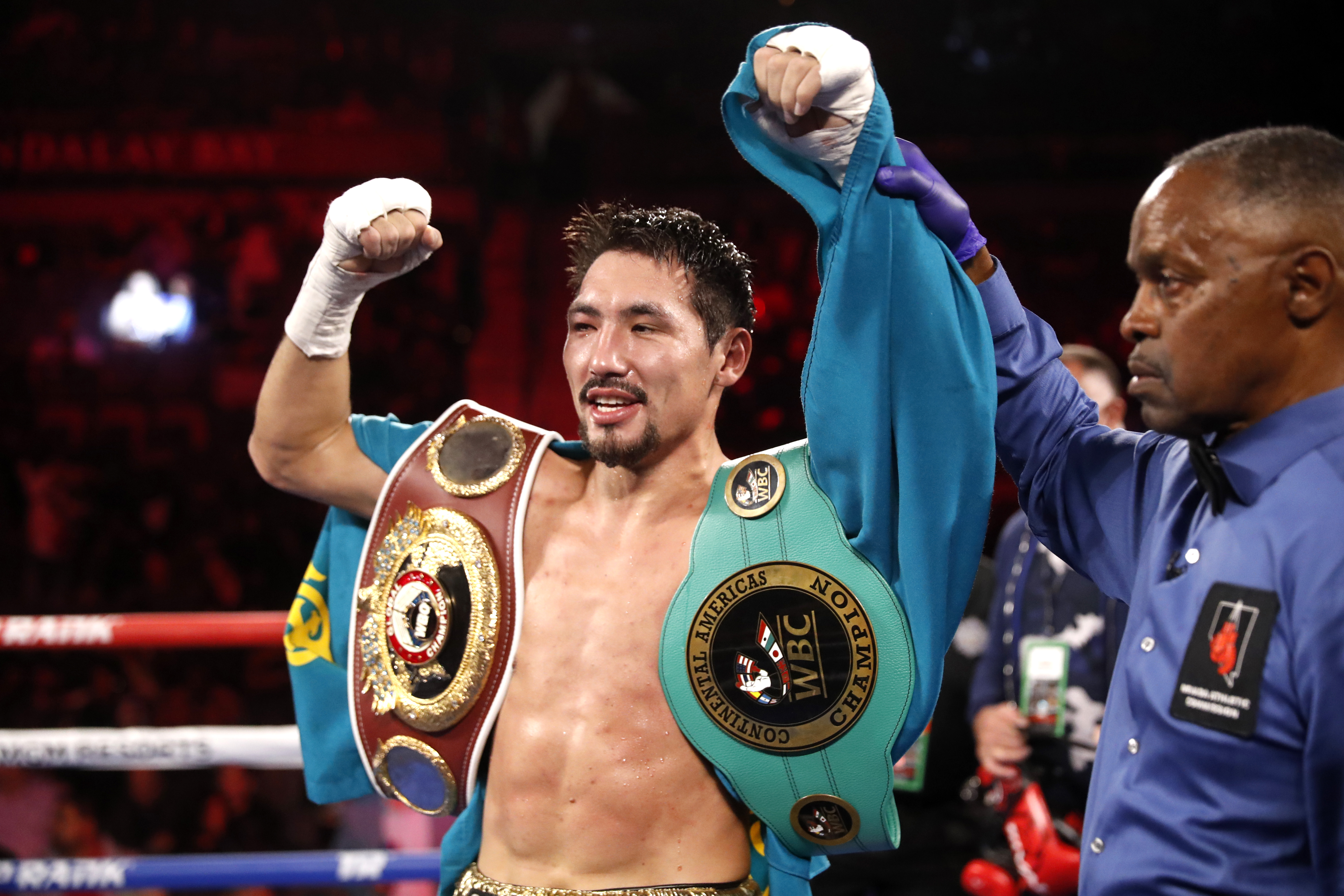
WBO president Gustavo Olivieri has categorically denied Hamzah Sheeraz's allegations of corruption after Janibek Alimkhanuly was installed as the mandatory challenger for Sheeraz's WBO super middleweight title.
Alimkhanuly, the former unified middleweight champion, failed a VADA anti-doping test for a banned substance just days before his scheduled three-belt unification with Erislandy Lara this past December.
The fight was canceled, but the WBO later terminated Alimkhanuly's suspension early and has now controversially installed him as Sheeraz's mandatory challenger, despite Alimkhanuly having never competed at 168 pounds.
Sheeraz was unhappy with the WBO's ruling and made his feelings clear in an interview with Uncrowned's Ariel Helwani this past month.
"I think it's a joke," Sheeraz said. "I think what the WBO have done here is disgraceful to the sport of boxing. What they're essentially doing is rewarding someone who has [tested positive], so to me, it doesn't make sense.
"What the WBO have done here — to me, it's corrupt," Sheeraz continued. "And I'll say it as it is, I feel like it's all based off relationships. These moves being made are all based off personal relationships or whatever it may be, because it's come out of nowhere and is extremely not right for the sport of boxing."
After the interview, Uncrowned reached out to Olivieri for a response to Sheeraz's comments.
"I respectfully but unequivocally disagree with his assertions, particularly any suggestion of 'corruption,' improper 'motives,' or decisions influenced by 'personal relationships,'" Olivieri told Uncrowned.
In a follow-up sent Tuesday, the WBO provided Uncrowned with a detailed explanation of why it ruled the way it did.
"First, Zhanibek never stepped inside the ring in connection with the anti-doping matter," Olivieri said. "The bout did not proceed. That fact materially distinguishes his case from other circumstances, including Ryan Garcia vs. Devin Haney, where the contest actually occurred and the anti-doping findings arose in connection with a completed championship bout. These are fundamentally different factual circumstances and should not be treated as interchangeable cases.
"Second, Zhanibek was a first-time offender. During the disciplinary proceedings, he presented mitigating circumstances for the WBO's consideration, including supporting medical evidence. The WBO nevertheless imposed disciplinary measures that were broader than the suspension imposed by the licensing commission governing his most recent bout in Kazakhstan."
Alimkhanuly was suspended for six months by the Kazakhstan Professional Boxing Federation (KPBF), while the WBO's suspension was twice as long. The WBO said when suspending Alimkhanuly that it reserved the right to modify the suspension, and ultimately did so "following the WBO's review of the complete record, including Zhanibek's cooperation and compliance with the relevant conditions."
The WBO has a longstanding tradition of allowing recent WBO champions to move up or down in weight and receive preferential consideration in that new weight class, and even become mandatory challenger.
One example Olivieri offered to Uncrowned was Keyshawn Davis.
Davis was stripped of his WBO lightweight title in June 2025. He then moved up to super lightweight and competed twice in that division in non-title bouts before jumping up to welterweight and being ranked No. 1 in the division. He was later named mandatory for Devin Haney, despite having never fought at 147 pounds.
Davis is just one of many cases where a recent WBO champion was made mandatory in a different weight class, even without fighting in that division. The Davis example is arguably the most relevant one, though, because it demonstrates how the precedent applies even for champions who may be considered not to be in good standing due to recent events.
Olivieri argued that Alimkhanuly (17-0, 12 KOs) was a stronger contender to be mandatory than the undefeated Jacob Bank (20-0, 11 KOs) because of the Kazakh's accomplishments at 160 pounds, which included being the unified WBO and IBF champion. Olivieri said that Bank's record and résumé were not comparable to Alimkhanuly's.
The WBO president concluded by insisting that Alimkhanuly's doping matter was concluded when his suspension ended, and had no bearing on his ability to be named the mandatory contender for Sheeraz.